This article is for self study
Given a 2D matrix matrix, handle multiple queries of the following type:
- Calculate the sum of the elements of
matrixinside the rectangle defined by its upper left corner(row1, col1)and lower right corner(row2, col2).
Implement the NumMatrix class:
NumMatrix(int[][] matrix)Initializes the object with the integer matrixmatrix.int sumRegion(int row1, int col1, int row2, int col2)Returns the sum of the elements ofmatrixinside the rectangle defined by its upper left corner(row1, col1)and lower right corner(row2, col2).
You must design an algorithm where sumRegion works on O(1) time complexity.
Example 1:
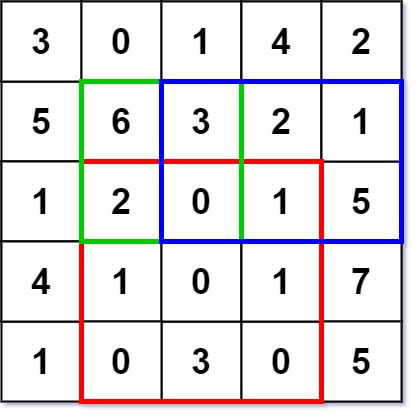
Input
["NumMatrix", "sumRegion", "sumRegion", "sumRegion"]
[[[[3, 0, 1, 4, 2], [5, 6, 3, 2, 1], [1, 2, 0, 1, 5], [4, 1, 0, 1, 7], [1, 0, 3, 0, 5]]], [2, 1, 4, 3], [1, 1, 2, 2], [1, 2, 2, 4]]
Output
[null, 8, 11, 12]

Explanation
NumMatrix numMatrix = new NumMatrix([[3, 0, 1, 4, 2], [5, 6, 3, 2, 1], [1, 2, 0, 1, 5], [4, 1, 0, 1, 7], [1, 0, 3, 0, 5]]);
numMatrix.sumRegion(2, 1, 4, 3); // return 8 (i.e sum of the red rectangle)
numMatrix.sumRegion(1, 1, 2, 2); // return 11 (i.e sum of the green rectangle)
numMatrix.sumRegion(1, 2, 2, 4); // return 12 (i.e sum of the blue rectangle)
Constraints:
m == matrix.lengthn == matrix[i].length1 <= m, n <= 200-104 <= matrix[i][j] <= 1040 <= row1 <= row2 < m0 <= col1 <= col2 < n- At most
104calls will be made tosumRegion.
We could trade in extra space for speed by pre-calculating all possible rectangular region sum and store them in a hash table. Each sumRegion query now takes only constant time complexity.

* following the green arrows we have calculated value of one twice, so we have to remove one once.
final formulation is as below:


This is how it looks:


we could pre-compute a cumulative region sum with respect to the origin at .


Take green areas and remove red
More generally the equations can be written as below:

But since we added one extra column and row this equation be written as :


package practice;

public class NumMatrix {

    private int[][] preSumMatrix;

    public NumMatrix(int[][] matrix) {
        if (matrix.length == 0 || matrix[0].length == 0) return;
        preSumMatrix = new int[matrix.length + 1][matrix[0].length + 1];

        for (int r = 0; r < matrix.length; r++) {
            for (int c = 0; c < matrix[0].length; c++) {
                preSumMatrix[r + 1][c + 1] = preSumMatrix[r + 1][c] + preSumMatrix[r][c + 1] + matrix[r][c] - preSumMatrix[r][c];
            }
        }

    }

    public int sumRegion(int row1, int col1, int row2, int col2) {
        return preSumMatrix[row1][col1] + preSumMatrix[row2 + 1][col2 + 1] - preSumMatrix[row1][col2 + 1] - preSumMatrix[row2 + 1][col1];
    }


    public static void main(String[] args) {
        int[][] matrix = {{3, 0, 1, 4, 2}, {5, 6, 3, 2, 1}, {1, 2, 0, 1, 5}, {4, 1, 0, 1, 7}, {1, 0, 3, 0, 5}};
        NumMatrix nm = new NumMatrix(matrix);
        System.out.println(nm.sumRegion(2, 1, 4, 3));
    }

}
No comments:
Post a Comment