This article is for self education
Given the root of a binary tree, flatten the tree into a "linked list":
- The "linked list" should use the same
TreeNodeclass where therightchild pointer points to the next node in the list and theleftchild pointer is alwaysnull. - The "linked list" should be in the same order as a pre-order traversal of the binary tree.
Example 1:
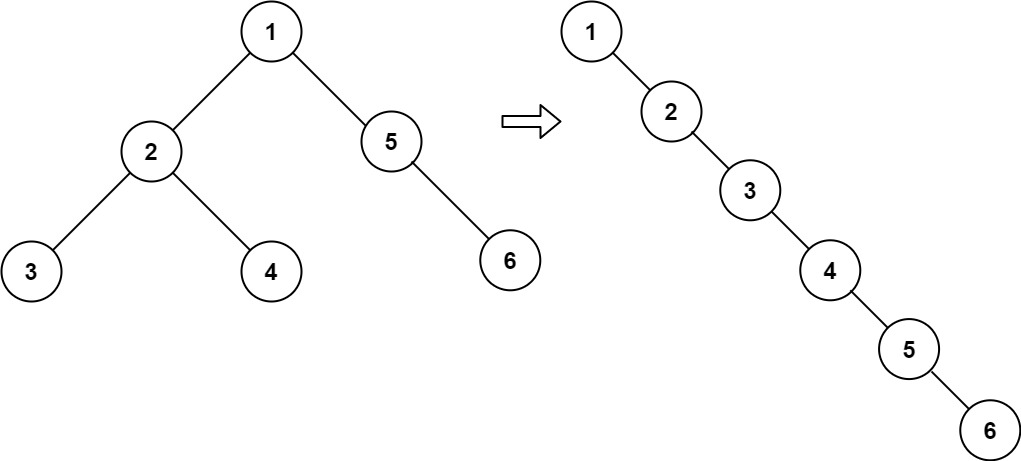
Input: root = [1,2,5,3,4,null,6]
Output: [1,null,2,null,3,null,4,null,5,null,6]
Example 2:
Input: root = []
Output: []
Example 3:
Input: root = [0]
Output: [0]
Constraints:
- The number of nodes in the tree is in the range
[0, 2000]. -100 <= Node.val <= 100
//method 1 iterative
 public void flatten(TreeNode root) {

      if(root==null) return ;

      TreeNode node=root;

      while(node!=null){

          if(node.left!=null){

              TreeNode rightmost=node.left;

              while(rightmost.right!=null){
                  rightmost=rightmost.right;
              }
              rightmost.right=node.right;
              node.right=node.left;
              node.left=null;
          }

          node=node.right;
      }


  }
refer:
https://leetcode.com/problems/flatten-binary-tree-to-linked-list/solution/


  //method 2 : using likedlist and recursion
/*  public void flatten(TreeNode root) {
      LinkedList<TreeNode> list= new LinkedList<>();
      preorder(list,root);

      if(list.size()>1){
          TreeNode head=list.get(0);
          TreeNode temp=head;

          for(int i=1; i<list.size(); i++){
              TreeNode node=list.get(i);
              temp.right=node;
              temp.left=null;
              temp=node;
          }
      }
  }

  private void preorder(List<TreeNode> list, TreeNode root){
      if(root== null) return;
      list.add(root);
      preorder(list,root.left);
      preorder(list,root.right);
  }

  */
No comments:
Post a Comment